

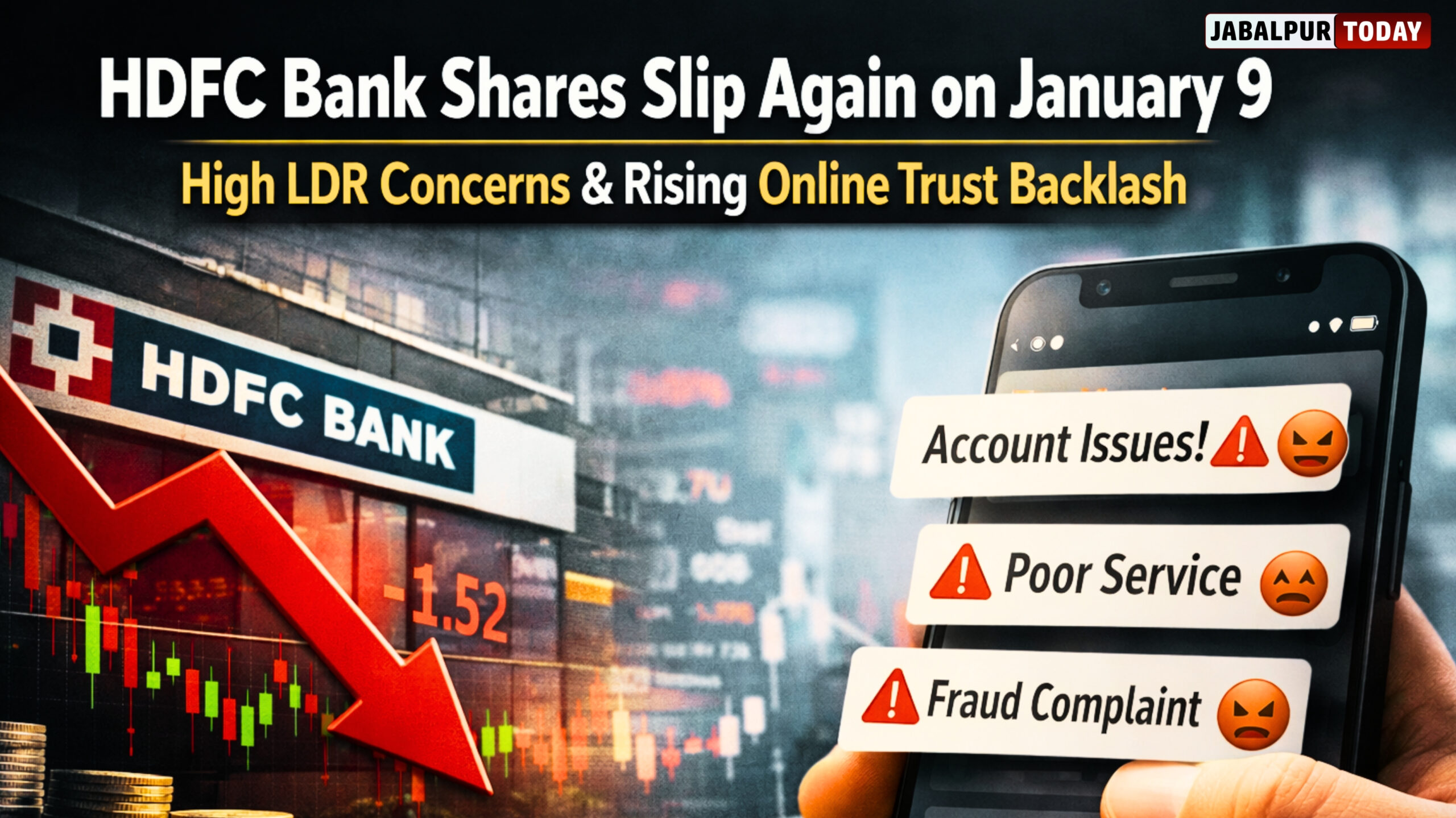
HDFC Bank shares remain under pressure ahead of Q3 earnings amid high loan-to-deposit ratio, slower deposit growth and rising customer trust concerns.
New Delhi: HDFC Bank shares remain under pressure as investors closely track the stock amid rising volatility. On January 9, 2026, the stock continued its downward trend, trading around ₹942–944 in morning sessions, slightly lower than its previous close of ₹946.70. Over the last few sessions, the stock has fallen nearly 4–5%, extending its losing streak.
While financial indicators are dominating headlines, a closer look shows that operational concerns and growing customer dissatisfaction are also unsettling investors. This combination of earnings anxiety and weakening trust is turning the current dip into more than just a routine market correction.
Current Price Snapshot: What’s Happening Today
On January 9, HDFC Bank shares opened near ₹945 and slipped to an intraday low of around ₹941. The cautious movement reflects investor nervousness ahead of the bank’s Q3 earnings announcement.
Trading volumes remain heavy, with over 21 crore shares traded recently on the NSE, even as the broader market remains weak. The stock’s decline has also weighed on benchmark indices like the Nifty, although domestic institutional investor (DII) buying has partly offset continued foreign institutional investor (FII) selling.
Why the Stock Is Falling: LDR Concerns and Market Pressure
The decline picked up pace after HDFC Bank’s Q3 business update, which raised concerns about its loan-to-deposit ratio (LDR). The LDR currently stands close to 99–100%, far above management’s comfort target of below 90%.
Following the merger, deposit growth has slowed, triggering fears that high LDR levels could restrict future loan growth and pressure profit margins. Even though loans grew 11.9% year-on-year to ₹28.4 lakh crore and deposits increased 11.5%, the market remains cautious.
Adding to the pressure are continued FII outflows, which formed part of nearly ₹1.6 lakh crore of selling in 2025, along with concerns over rich valuations in the banking space.
Q3 Results Watch: What Investors Expect on January 17
HDFC Bank is scheduled to announce its Q3 results on January 17, and expectations are high. Investors will closely monitor net interest income (NII), asset quality, and any signs of margin recovery.
Analysts expect profit after tax (PAT) growth of around 11% year-on-year, but the key focus will be management commentary on LDR control and plans for growth acceleration toward FY27. A strong earnings surprise could trigger a rebound, while in-line results may keep the stock under pressure.
2026 Price Targets: Analysts Remain Positive
Despite the recent fall, analyst sentiment remains largely bullish. Average target prices range between ₹1,165 and ₹1,195, with some estimates going as high as ₹1,460. Over 36 analysts currently maintain a “Strong Buy” rating.
Brokerages such as Motilal Oswal, which has set a target of ₹1,175, continue to highlight the bank’s strong deposit franchise. Analysts also expect non-performing assets (NPAs) to decline to around 1.9% by 2027, which could lead to a valuation rerating if operational metrics improve.
Buy, Sell, or Hold? What Investors Are Debating
With the stock under pressure, investor queries around whether to buy, hold, or sell have surged. Long-term investors point to HDFC Bank’s strong track record of wealth creation over decades, along with a 2–3% dividend yield.
In the short term, however, caution dominates due to unresolved LDR concerns. Some investors see the decline as a gradual accumulation opportunity, especially for those willing to wait for a potential turnaround in FY27.
Latest Developments: Block Deals and Online Chatter
Recent activity includes large block deals worth around ₹1,756 crore, which have added to short-term volatility. At the same time, the bank continues to show steady business growth.
On social media, sentiment is mixed. While many highlight HDFC Bank’s 22.3% market share in credit cards, others raise concerns over service delays and customer experience issues, contributing to uneasy sentiment.
The Trust Angle: Customer Complaints Adding to Volatility
Beyond balance-sheet numbers, customer grievances are increasingly influencing investor sentiment. Online complaints related to fraud resolution delays, account access problems, and inheritance-related issues are gaining visibility.
In a market where retail participation is growing, such trust-related issues can hurt customer loyalty and, over time, impact deposit growth. As online searches increasingly link these complaints to stock performance, the reputational aspect is becoming an important factor behind the volatility.
Long-Term Outlook: Strength Tested but Not Broken
HDFC Bank has historically delivered strong long-term returns and could aim for new highs in 2026–27 if asset quality remains stable and deposit growth improves. While risks related to prolonged high LDR levels persist, the bank’s market leadership and scale provide a solid foundation for recovery.
As current market searches reflect a mix of uncertainty and opportunity, this phase is testing investor patience. For those evaluating positions, balancing financial fundamentals with market sentiment and customer trust will be crucial. The upcoming Q3 results may set the tone — until then, volatility is likely to continue.